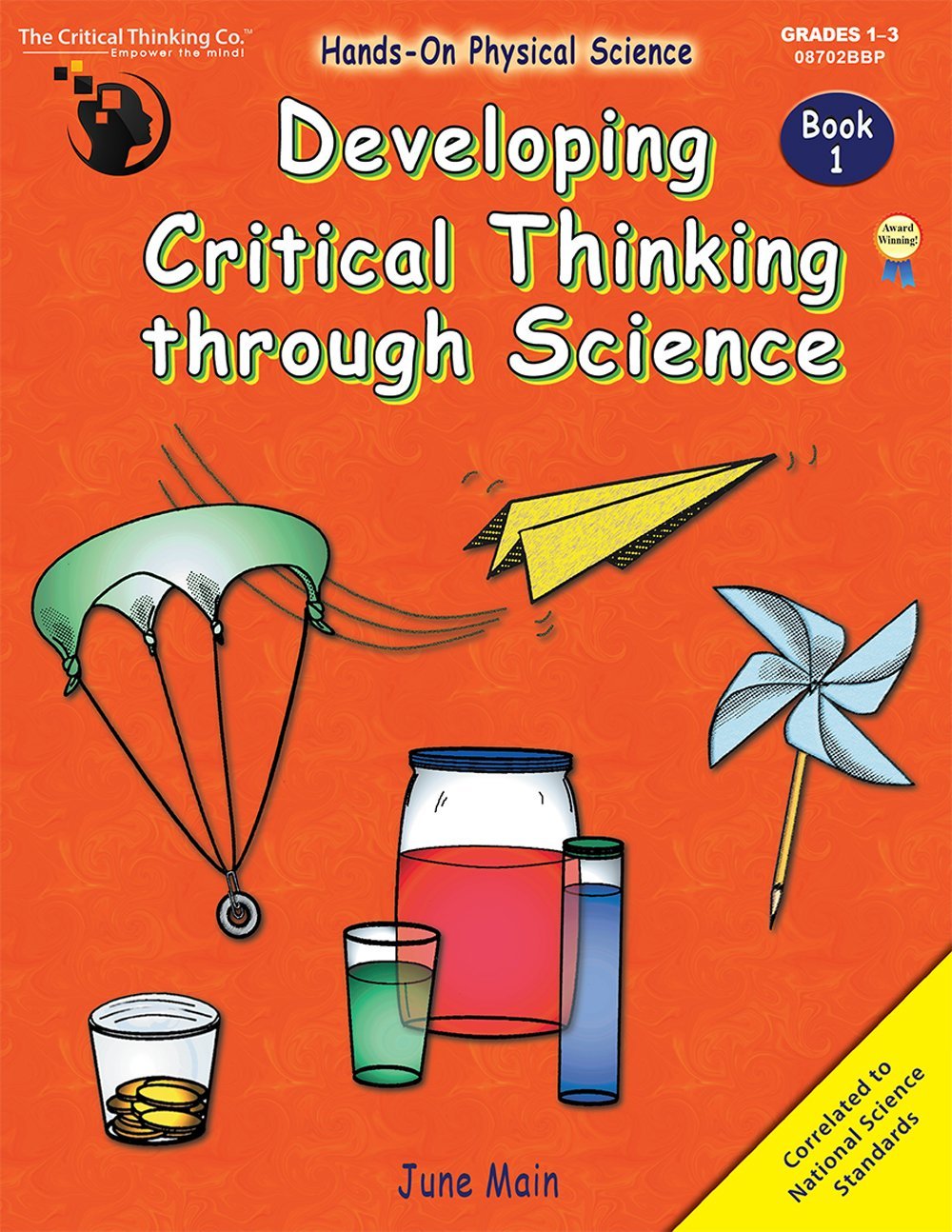
Developing Critical Thinking through Science Book 1 Workbook - Hands-On Physical
$9.99
(It may be possible to pay only $8.89 instead of $9.99 when you
use your bCredits at checkout)
Sign up and get $15.00 bCredits free to use at checkout and another $5.00 bCredits when you make your first purchase.
More info
To learn more about bCredits, please click again on the icon or click here
Share & earn! Sign in, share this or any listing, and you’ll get commission when it sells.
Learn more
1st 2nd 3rd Elementary School Gifted Scientific Method Life observe force buotancy surface tension pressure space Mensa Activities Practice Gifted Workbook Test Prep Standards Curriculum Process
The fun, hands-on physical science lessons/experiments in this 168-page book teach science principles found in state and national science standards. Students also learn and practice critical thinking through the application of the scientific metho...
visually inspected by Bonnie: paperback, copyright 1991, different book cover as pictured, good condition on pages and binding, only little marking on bookcover, no marking text, shelf wear
Additional Details
------------------------------
Product description: The fun, hands-on physical science lessons/experiments in this 168-page book teach science principles found in state and national science standards. Students also learn and practice critical thinking through the application of the scientific method of investigation. Each activity is a 10- to 30-minute guided experiment in which students are prompted to verbalize their step-by-step observations, predictions, and conclusions. Reproducible pictures or charts are included when needed, but the focus is inquiry-based, hands-on science.
Preparation time is short, and most materials can be found around the classroom. Step-by-step procedures, questions, answer guidelines, and clear illustrations are provided. Practical applications at the end of each activity relate science concepts to real-life experiences. These activities can be used successfully with a minimum of science knowledge, preparation time, and science equipment. The lessons/experiments teach science following these four important educational themes:
• Science can and should motivate students toward learning and toward developing curiosity about the world in which they live.
• Science is viewed as an active process of developing ideas, or "storybuilding," rather than as static bodies of already-existing knowledge to be passed on to students.
• Students are encouraged to observe and describe their observations accurately and completely using scientific terminology.
• An open, interactive atmosphere in the classroom is essential.